
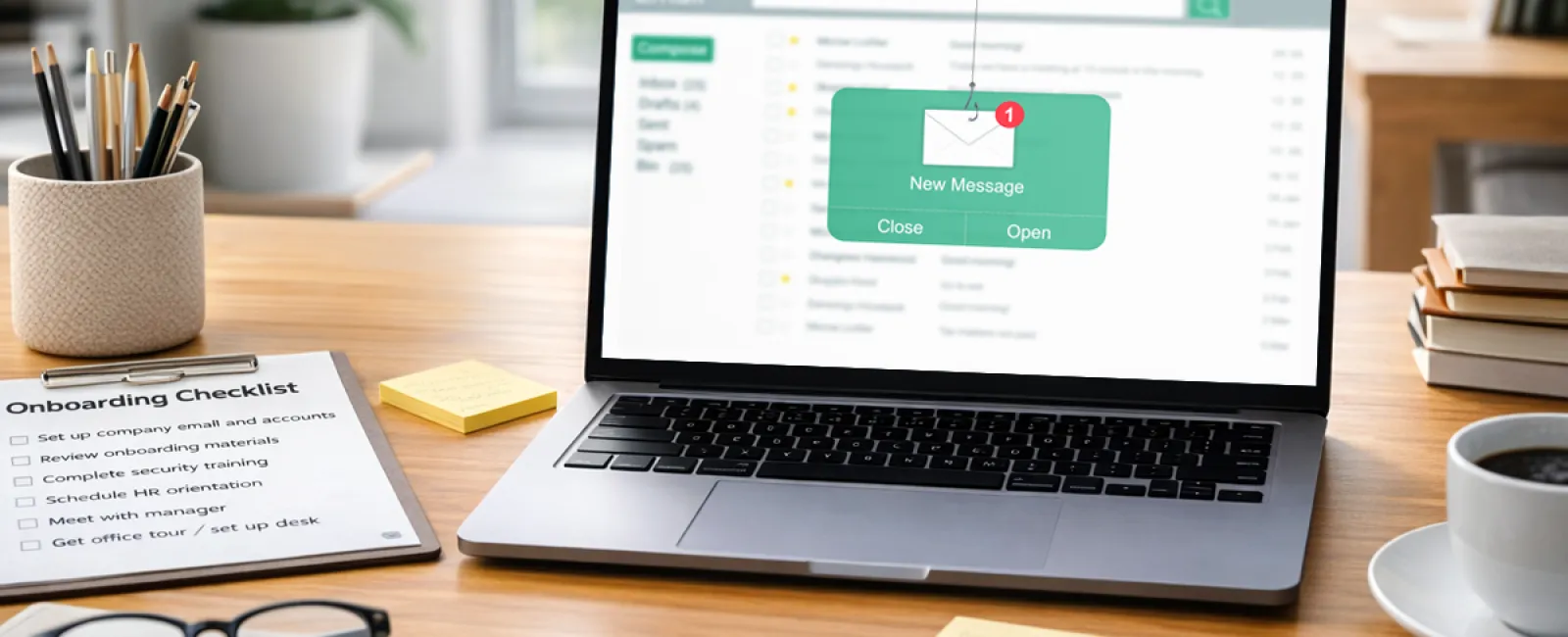
An email lands on a Tuesday morning.
It appears to come from the CEO. The sender name checks out. The wording sounds authentic. Even the signature feels legitimate.
"Hey — can you help me with something fast? I'm stuck in meetings all day. Please handle a vendor payment for me. I'll explain later."
The new hire stops and thinks.
They've only been at the company for four days. They're still learning the workflow, still unsure what's normal, and certainly not eager to challenge what looks like a request from the CEO in their first week.
So they comply.
And in that moment, the breach begins.
Why the first week is the biggest risk
Every spring, organizations welcome a fresh group of new employees, including recent graduates and summer interns stepping into their first professional roles. For businesses, it's onboarding season. For threat actors, it's prime time.
According to Keepnet Lab's 2025 New Hires Phishing Susceptibility Report, CEO impersonation emails are 45% more likely to succeed with new hires than with experienced employees.
Attackers don't target your most seasoned team members first. They focus on the people still getting oriented, because early on, everything is unfamiliar and confidence is low.
A new employee doesn't yet know what a legitimate request looks like. They don't know how leadership normally communicates. They haven't had time to build pattern recognition or trust in their own judgment, and criminals exploit that uncertainty.
But the real issue isn't the new hire. The most vulnerable employee is rarely the least capable; it's the one who's trying hardest to be helpful.
If you manage a team, you probably already know who would respond first.
The problem isn't just training. It's the process.
Now picture that employee's first day.
The laptop isn't ready. Access isn't fully provisioned. The email account is still pending. They borrow a coworker's login to get something done quickly. They save files on their desktop because the shared drive isn't available yet. They use a personal phone to look up a client number because it's faster.
None of it seems dangerous in the moment. It feels efficient. It feels like initiative on a hectic first day.
But during that first week, when systems are incomplete, small risks quietly add up. Shared credentials leave behind untracked accounts, files sit outside your backup environment, personal devices touch company data, and no one explains what to do when something feels suspicious.
The same Keepnet report found that new employees are 44% more susceptible to phishing than tenured staff. That gap isn't caused by negligence. It's created by disorganization. When onboarding is messy, security becomes an afterthought. That's exactly where the phishing email fits in.
The attack didn't invent the weakness. The first day exposed it.
What a secure first day should include
Closing this gap doesn't require an hour-long lecture on cybersecurity. It requires three basics to be in place before the employee ever arrives.
1. Their access is fully set up, not improvised.
That means the laptop is ready, logins are created, and permissions are clearly assigned. No borrowed credentials, no temporary fixes, and no "we'll handle it later this week."
2. They understand what normal looks like in your organization.
This can be a quick 10-minute check-in. Does the CEO ever email about payments? Does anyone? What should they do if a message feels suspicious? This isn't a formal training session; it's practical orientation.
3. They have a safe place to ask questions.
The employee who hesitated before opening that email likely would have asked for help if they knew exactly where to turn. Most first-week mistakes happen silently because new hires don't want to look unsure.
Give them a person. Give them a path.
Most security incidents don't happen because someone chooses to ignore the rules. They happen because the rules haven't been made clear yet.
Maybe your onboarding process is already strong. Maybe your team is small enough that the first few days feel hands-on rather than formal. But if a new hire has ever had to piece together week one on their own — or if you're bringing someone on this spring — it's worth tightening the process before that Tuesday email shows up.
Click here or give us a call at 920-818-0900 to schedule your free 15-Minute Discovery Call.
And if another business owner is hiring soon, send this their way. The easiest time to secure the door is before the first person reaches for the handle.


