
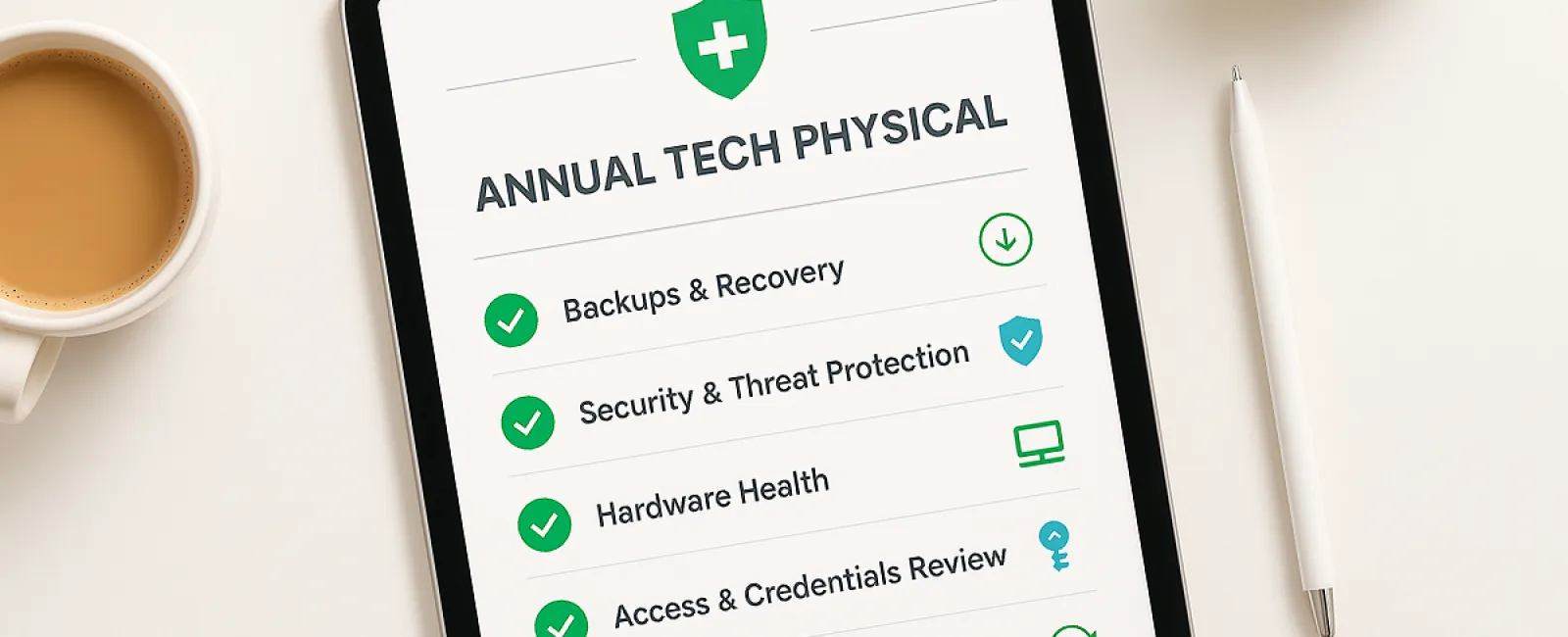
January often becomes the catch-up month for tasks we've long delayed.
Doctor's visits, dental checkups, or even finally investigating that strange noise in your car.
Preventive maintenance may seem tedious, but it's far less costly than facing a crisis that could have been avoided.
So, let's confront a vital question:
When was the last time your company's technology underwent a thorough health review?
Not a quick fix like "the printer was repaired last week," but a comprehensive checkup.
Because simply "functioning" and truly "healthy" are worlds apart.
Avoid the "I Feel Fine" Illusion
Many skip medical exams when they feel no pain.
The same mindset often causes businesses to overlook IT evaluations, thinking:
"Everything's up and running."
"We don't have time."
"We'll handle issues if and when they arise."
But tech issues rarely come with warnings.
Like hypertension or a hidden cavity, technology problems can quietly escalate until they demand immediate action.
Technology behaves similarly.
Most IT failures that catch small businesses off guard are due to:
- Identified risks that were ignored
- Outdated hardware that seemed fine—until it suddenly failed
- Backups that existed but failed when needed
- User access that was never properly audited or cleaned up
- Regulatory compliance gaps unnoticed by the team
Your systems might operate daily, yet still be one malfunction away from a crisis.
What a Comprehensive Tech Checkup Entails
A professional technology evaluation examines your systems with the same thoroughness as a medical checkup, uncovering hidden issues before they become serious threats.
Key Indicator: Backup and Recovery
This represents the lifeline of your IT health. If every other system fails, can you restore your data and operations?
• Are your backups completing successfully, not just scheduled?
• When was the last time you tested restoring files to guarantee their integrity?
• If your main server crashed Monday at 9 a.m., how soon could you resume work? Do you have a documented answer?
Many companies only learn their backups are faulty during a disaster—much like realizing your airbags don't deploy during a car accident.
Core Health: Hardware and Network Infrastructure
Hardware doesn't fail gently — it degrades over time. Support lifecycles end, performance deteriorates, and ultimately, devices break down unexpectedly.
- How old is your essential equipment like servers, firewalls, and workstations?
- Is any of your critical hardware no longer supported by the manufacturer, leaving it vulnerable?
- Are you proactively replacing aging equipment, or waiting for catastrophic failure?
Neglecting hardware aging is a primary contributor to unforeseen downtime, causing gradual slowdowns followed by total shutdowns.
Security Check: Access Control and Credential Management
Who currently has permissions within your systems? If you're unsure or can only guess, it's time for a review.
- Can you provide an up-to-date list of everyone with access?
- Are former employees or outdated vendors still active in your systems?
- Are shared accounts used without accountability?
Unchecked access accumulations—known as access creep—pose serious security risks, often due to lack of time rather than negligence.
Emergency Preparedness: Disaster Recovery Plans
Thinking about worst-case scenarios is uncomfortable but essential.
- Do you have a clear, realistic plan if ransomware attacks tomorrow?
- Is that plan documented and regularly tested?
- How long could your business operate without your IT systems?
Waiting to "figure it out" during a disaster is not a plan—it's a risk.
Industry Compliance and Specialized Requirements
Depending on your sector, maintaining "compliance" is not optional and is closely monitored.
- In healthcare, HIPAA violations can incur fines exceeding $50,000 per incident.
- If you process payments, PCI compliance is critical; failure could cost your ability to accept cards.
- Many contracts now demand strict security standards—these are increasingly enforced.
Generic IT advice won't suffice—you need expertise tailored to your industry's unique demands.
Signs You're Long Overdue for a Checkup
If statements like these resonate, it's time to act:
"I think our backups are working." (Thinking isn't enough.)
"Our server is old but still running." (Just like a car before a breakdown on the highway.)
"We probably have ex-employees still listed in the system." (Probably isn't certainty.)
"We have a disaster plan... somewhere." (If it's not accessible within 30 seconds, it might as well not exist.)
"If [name] left, we'd be in trouble." (Single points of failure always lead to failures.)
"We'd likely fail an audit, but no one's asked yet." (Yet.)
The Price of Neglecting IT Health
A preventive checkup takes hours.
An IT failure can cost days, weeks, or even put your business at risk.
The consequences are costly:
Data Loss: Broken backups and system failures can erase vital records, financial data, and project files—sometimes permanently.
Downtime: Every moment your IT systems are offline means lost productivity, revenue, and trust.
Regulatory Fines: HIPAA fines can exceed $50,000 per breach; PCI failures may revoke payment processing capabilities; new privacy legislation continues to tighten penalties.
Ransomware: Recovery costs for small businesses frequently reach six figures, including ransom payments, remediation, lost revenue, and damage to reputation.
Preventative measures might feel dull, but they're far cheaper and less stressful than dealing with an IT disaster.
Why You Need an Expert for Your Tech Health
You wouldn't evaluate your own blood pressure without professional training.
Similarly, technology requires a skilled professional who understands the nuances, has the right tools, and can identify issues invisible to untrained eyes.
Choose someone who:
- Understands what healthy looks like for businesses your size and industry—not generic IT guidelines but tailored standards.
- Knows common pitfalls for businesses like yours and can detect minor symptoms that point to major problems.
- Offers a fresh perspective, catching issues normalized by daily exposure.
This approach focuses on preventing fires before they start, not merely reacting once they ignite.
Book Your Annual Technology Checkup Today
Since you're already scheduling your other important health appointments this January, don't forget your essential IT checkup.
Schedule your Annual Technology Physical with us.
We'll provide a clear, jargon-free assessment outlining your systems' current health, identifying risks, and recommending steps to prevent emergencies.
No pressure—just straightforward, actionable clarity.
Click here or give us a call at 920-818-0900 to book your 15-Minute Discovery Call.
The best way to avoid an IT emergency is to catch problems early.
That time is now.


